Posts

Showing posts with the label Life Science training programs in Lucknow biotech research centre lucknow summer internship for biotechnology students in lucknow biotechnology training in lucknow

Experiome Inc-Biotech Research Centre in Lucknow | Biotech Training in Lucknow

Image
  Experiome Organized a Guest Lecture Experiome organized a Guest Lecture on August 27, 2022, entitled, Fundamentals of Recombinant DNA Technology. The lecture was delivered by Dr Chandra P Chaturvedi, Associate Professor, Department of Hematology, SGPGIMS, Lucknow. Team Experiome would like to sincerely thank Dr Chaturvedi for sharing his experiences and insights about the tools, techniques and applications of recombinant DNA technology Biotechnology Projects for Undergraduate and Postgraduate Students in Lucknow | Training Programs in Bioinformatics in Lucknow | Biotech Research Centre in Lucknow | Biotech Training in Lucknow

Experiome Inc-Biotech Research Centre in Lucknow

Image
  Guest Speaker: Dr Chandra Prakash Chaturvedi, PhD Associate Professor, Department of Hematology, SGPGIMS, Lucknow Title of the talk: Fundamentals of Recombinant DNA Technology Life Science Training Centre in Lucknow | Biotech Research Centre in Lucknow | Summer Internship for Biotechnology Students in Lucknow | Biotech Training in Lucknow
Biotech Research Centre in Lucknow | Biotech Training in Lucknow | Experiome Inc
Image
  15-Day Online Bioinformatics Training Program for Rs 2000 only. Learn biological sequence analysis by MEME suite, Clustal Omega, MEGA, TBtools, etc Call Now- 072669 91117 Life Science Training Centre in Lucknow | Biotech Research Centre in Lucknow | Summer Internship for Biotechnology Students in Lucknow | Biotech Training in Lucknow

Experiome Is Launching Again the Hugely Successful

Image
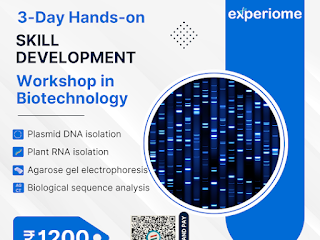
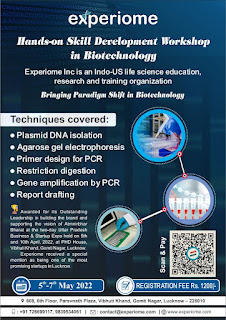
  Experiome is launching again the hugely successful "3-Day Hands-on Skill Development Workshop in Biotechnology" Contact us to join the workshop- +91 72669 91117, 9839534061 Life Science Training Centre in Lucknow | Biotech Research Centre in Lucknow | Summer Internship for Biotechnology Students in Lucknow | Biotech Training in Lucknow
Polymerase Chain Reaction (PCR) | Experiome Inc

  Polymerase Chain Reaction (PCR) An American biochemist named Kary B. Mullis invented PCR in 1983. Prior to the advent of PCR, the process of amplifying, or making copies of, recombinant DNA fragments was time- consuming and labor-intensive. The polymerase chain reaction (PCR), sometimes known as "molecular photocopying," is a simple and inexpensive process for amplifying, or copying, small pieces of DNA. Because molecular and genetic analyses require large amounts of DNA, studies of isolated fragments of DNA are nearly impossible without PCR amplification. To amplify the DNA segment in PCR, the template DNA is heated for its denaturation. Taq polymerase is an enzyme that creates two new strands of DNA using the previous strands as templates. This process causes the original DNA to be duplicated, with each new molecule comprising one old and one new strand of DNA. Then, for each of these strands, two new copies can be made, and so on. Denaturing and synthesizing ...

Reverse Breeding | Experiome Inc

 Reverse Breeding Reverse breeding is used to establish parental lines for desired hybrid lines (not genetically modified). Homozygous lines are produced from heterozygous plants to achieve this. This is accomplished by introducing a gene that prevents recombination during meiosis into the heterozygous line (the hybrid). As a result, the genetically engineered plant's haploid gametes have completely non-recombined chromosomes. After that, the gametes can be used to create plants. Only non-genetically modified plants are used, and those that have the transgenic DNA are removed. Genes that aid recombination in meiosis can be suppressed via RNAi. Meiotic recombination involves a number of genes. Biotechnology Training Program in Lucknow Asy1 or sds, which ensure that homologous chromosomes pair in the first phase of meiosis, are genes that can be silenced. Furthermore, the spo11-1gene, which is responsible for the occurrence of double-strand breaks during recombination, can b...

Ethics and Requirements of Plant Tissue Culture Laboratory | Experiome Inc

  Ethics and Requirements of Plant Tissue Culture Laboratory Plant tissue culture generally refers to   in vitro culture of all plant parts under sterile conditions. Basic facilities are must in the laboratory where tissue culture technology is to be performed. This includes general cleaning and media preparation, sterilization, storage, sterile transfer, observation / data acquisition, and environmentally controlled incubator or culture room areas. The most important work area is the Cultural Transfer Office, where   core activities take place. Plant tissue culture should be cultured for a specified period of time under well-controlled temperature, humidity, airflow, and light quality. Plant culture techniques require a variety of organic and inorganic chemicals to prepare the   culture medium. The growing room is an equally important area where plant cultures are maintained under controlled environmental conditions for optimal growth. After in vitro culture of plan...

Summer Internship for Biotechnology Students-Experiome Inc

  Human genome Project Renato Dulbecco was the first to propose sequencing the human genome in 1984 to understand about cancer. The National Academy of Sciences in the United States first proposed HGP in 1988, followed by the National Institutes of Health and the Department of Energy. In 2003, the project was publicly established and declared. This project is still the largest collaborative biological effort in the world. Australia, Brazil, Canada, France, Germany, Japan, and the United Kingdom are among the countries participating in the initiative. It was a big problem to map out genes despite spending a large sum of money on it, starting at around $3 billion. In addition, the project experts revealed that roughly 1.5 percent of DNA leads to the synthesis of proteins. This raises the question of what the other 98.5 percent of DNA, known as non-coding DNA, performs. Summer Internship for Biotechnology Students in Lucknow . Over the last 20 years, scientists have had unpreceden...

Biotechnology Training Program in Lucknow | Biotechnology Training and Research Lab in Lucknow | Experiome Inc

  CRISPR-Cas use to meet the need of Vitamin A Nutrition is essential for healthy growth and development. Macronutrients or micronutrients are the two types of nutrients.   Macronutrients include fats, protein, carbohydrates and other nutrients. However, micronutrients that include vitamins and minerals are more important.   The amount of micronutrients in a child's diet can have an effect on their mental and physical development. Training Programs in Bioinformatics in Lucknow Vitamin A is a lipid soluble vitamin. It is necessary for cell growth and metabolism.   Vitamin A can naturally be found in dark leafy greens and orange-colored vegetables as well as milk products, liver and fish. Vitamin A deficiency can be a concern for children living in poverty.   UNICEF states that one-third of children don’t get vitamin A supplements, while WHO estimates that 190million pre-school children worldwide are vitamin A deficient. According to a National Nutrition Monitorin...

Life Science Training Centre | Biotech Research Centre | Summer Internship for Biotechnology Students | Biotech Training | Biotechnology Summer Training | Short Term Biotechnology Training Centre | Training Programs in Bioinformatics

Immunoblotting Immunoblotting, often known as western blotting, is a technique for separating proteins by molecular weight. Two gels are created in this technique: a stacking gel pH (6.8) and a separating gel pH (8.8). The samples are put onto an acidic stacking gel, which separates proteins poorly but allows them to form narrow, highly defined bands. Smaller proteins travel quicker than larger protein molecules on a separating or resolving gel used to separate proteins based on their size. When voltage is supplied to the protein before loading, it is denatured and has a negative charge that travels towards the positive electrode. After the protein separation, the gel is sliced and inserted in a sandwich of fibre pad and filter sheets with a membrane (PVDF or nitrocellulose) and placing it in the tank with the transfer buffer with overnight transfer of protein to the membrane. After the protein has been transferred to the membrane, it is blocked by blocking solution to prevent antibodi...

Experiome | Summer Training in Biotechnology and Bioinformatics

  Experiome | Summer Training in Biotechnology and Bioinformatics CRISPR-Casuse to meet the need of Vitamin A Nutrition is essential for healthy growth and development. Macronutrients or micronutrients are the two types of nutrients. Requirements of macronutrients including fats, proteins, and carbohydrates are relatively higher to that of micronutrients including several vitamins and minerals. In comparison, if the amount of micronutrients in the diet is low, it has an impact on the child's physical and mental development. Vitamin A is a lipid-soluble vitamin that is required for cell growth, metabolism, immunological function, eyesight, and reproduction. It is absorbed in the duodenum and stored in hepatic stellate cells, as well as in adipose tissue and the pancreas in small amounts. Vitamin A is found naturally in dark leafy greens, orange-colored vegetables, milk products, liver, and fish. Vitamin A intake should be around 200 micrograms per day for children aged 1 to5, 70...

Summer Training in Biotechnology and Bioinformatics | Experiome

Image
  Biotech Training| Experiome Experiome is organising a 3-day Hands on Skill Development Workshop in Biotechnology  Spirulina is a blue-green algae or cyanobacteria which is found in high-salt alkaline water, subtropical and tropical places such as America, Mexico, Asia, and Central Africa.  It’s asexual reproduction reduces the danger of gene escape into the food chain, as well as the accompanying food security and regulatory concerns. It contains a lot of macro and micronutrients, important amino acids, proteins, lipids, vitamins, minerals, and antioxidants. With these characteristics, photosynthetic cyanobacteria have been used in a variety of industries, including food, health, and pharmaceuticals. It is consumed mainly in central Africa and later NASA started using spirulina as a nutritional supplement for astronauts on space missions. It gained attention for therapeutic benefits like hypercholesterolemia, hyperglycerolemia, cardiovascular diseases, inflammator...

Biotech Training And Research Centre In Lucknow | Experiome

Use of Genetically Engineered Cyanobacteria in Therapeutics Spirulina is a blue-green algae or cyanobacteria which is found in high-salt alkaline water, subtropical and tropical places such as America, Mexico, Asia, and Central Africa.   It’s asexual reproduction reduces the danger of gene escape into the food chain, as well as the accompanying food security and regulatory concerns. It contains a lot of macro and micronutrients, important amino acids, proteins, lipids, vitamins, minerals, and antioxidants. With these characteristics, photosynthetic cyanobacteria have been used in a variety of industries, including food, health, and pharmaceuticals. It is consumed mainly in central Africa and later NASA started using spirulina as a nutritional supplement for astronauts on space missions. It gained attention for therapeutic benefits like hypercholesterolemia, hyperglycerolemia, cardiovascular diseases, inflammatory diseases, allergies, cancer and viral infections.  Spirulina, ...

Biotechnology Summer Training in Lucknow | Experiome

  BIOTECHNOLOGY:India’s Sunrise Sector Biotech sectors have seen a spike in start-ups in recent years, with the goal of becoming a 5 trillion business by 2024, earning them the moniker "India's Sunrise Sector." India has risen from 52 nd to 46 th place between 2019-2021, with a 12.5 percent increase in 2020. Over the last five years, the bioeconomy has seen a nearly 95% increase in valuation, with the COVID-19 epidemic increasing it even more. In recent times, the Bio Economy's contribution to nation ’s GDP has increased steadily. The Bio Economy contributed 1.7 percent of GDP in 2010, but just by 2020, it has jumped to 2.7 percent. The sector is also generating more to nation ’s GDP and is a crucial component of India's goal. Biotechnology requires both physical (roads, railroads, ports) and scientific (incubators, equipment, animal rearing, etc.) infrastructure. India has made considerable progress in terms of physical infrastructure and now has to concentra...

Biotech Training And Research Centre In Lucknow | Experiome

Image
  Life Science Training Programs in Lucknow | B iotech Research Centre Experiome Inc organising a webinar on "Perspectives on Genome Analysis and Editing: NGS and CRISPR-Cas" under the aegis of Vignan's University Register for summer training and project dissertation for 2022 Transforming Biotechnology Training landscape with Experiome Inc. Connect with us: contact@experiome.com  Follow us on Facebook and LinkedIn +91-9839534061 Life Science training programs in Lucknow | Biotech Research Centre Lucknow | Training Programs in Bioinformatics in Lucknow | Summer Training in Biotechnology and Bioinformatics

Biotech Training And Research Centre In Lucknow | Experiome

Image
Experiome| Biotech Training In Lucknow We are a part of Vocal for Local, a government of India initiative. Join us for biotechnology training and research programs. Transforming Biotechnology Training landscape with Experiome Inc. Connect with us: contact@experiome.com Follow us on Facebook and LinkedIn +91-9839534061 Life Science training programs in Lucknow | Biotech Research Centre Lucknow | Training Programs in Bioinformatics in Lucknow | Summer Training in Biotechnology and Bioinformatics